
Back to blog
May I Hug You? – A Letter to Everyone Who Wants to Hug Me
A father's letter for Hug Day: why “May I hug you?” creates safety, and why a “no” is not a rejection of you.

May I Hug You?
A letter to everyone who wants to hug me
Dear You,
who is walking toward me right now with open arms. Or toward my child. Or toward anyone you love.
I know you do it out of love. I know a hug means warmth to you, connection, an unspoken “I'm glad you're here.” I'm not trying to talk you out of it.
I'm only asking that before you reach us, you stop for a moment and ask:
“May I hug you?”
Let me tell you why those few words matter so much to me.
Where I'm coming from
I'll start with my own experience.
For me, this question isn't only about being considerate. It's also about how my body experiences closeness. I can't stand it when people get too close to me.
For example, I've never been able to bear someone else tying my tie. Those few moments when another person leans in close and their hands fumble around my neck. Even though they always did it out of love, or wanting to help.
Maybe that's why I always pay attention to this.
“In our family, “May I hug you?” isn't just about being polite. It's simply how we talk to each other.”
Share:Share
When the body says something different from the heart
Many autistic people and people with ADHD experience touch differently. This is often called sensory sensitivity. What is a warm, quick hug to you can feel too strong, too sudden, too close to someone else. It's as if someone unexpectedly cranked up the volume on an otherwise lovely song.
And it isn't the same for everyone either – that's why we talk about a spectrum. Some people actively crave a strong, tight hug, but only when they decide on it and know what's coming.
Temple Grandin, one of the best-known autistic scientists in the world, has written about how as a child she longed for calming, deep pressure, yet found it hard to bear being hugged by people. As a young adult she eventually built herself a squeeze machine – she called it her “hug machine” – in which she could control how much pressure she got, and for how long.
“To me, the machine isn't the point of this story. The point is that she got to decide.”
Share:Share
The “no” isn't about you
If you ask and the answer is no, one sentence is enough.
That's all it takes
You
“May I hug you?”
Them
“Not right now.”
You
“Okay, not right now.”
No explanation needed, no persuading, no “oh, come on, just a little one.”
I know it can sting a little, and you may feel that you are the one being rejected. But that isn't true. In that moment, they simply don't want to be touched. Maybe tomorrow the answer will be different, or maybe they'll be the one to reach out to you.
Maybe in an hour. Maybe never, and that's okay too.
The most beautiful gift you can give in that moment is not to take offence.
“Because if a “no” is met with hurt feelings, next time it will be harder to say no. And harder to say an honest yes, too.”
Share:Share
There are many ways to connect
If a hug doesn't feel right in that moment, maybe something less close would be welcome:
“Okay, how about a fist bump?”

Because connection comes in so many forms:
- a fist bump or a high five,
- a wave from a little further away,
- a heart made with your hands,
- a smile that says just one thing: I see you,
- sitting quietly side by side,
- a game together where nobody has to talk.
“These aren't “substitutes”. They are worth just as much, and they say the same thing: you matter to me.”
Share:Share
It's not only about hugs
Hugs are just one example. Everyday life is full of situations where it means just as much to have a choice.
- Eye contact: some people find it easier to listen when they don't have to look you in the eye.
- Call or message: an unexpected phone call can be far more draining than a message they can answer in their own time.
- A crowded family lunch: a quiet room to retreat to can help a lot.
- New food on the table: instead of “just try it”, it's enough to say “it's here if you'd like some.”
The same three steps work everywhere:
1
Ask
Before you step in, before you touch, before you decide for them.
2
Offer a choice
A fist bump instead of a hug, a message instead of a call, a quiet room during lunch.
3
Respect the answer
Even when it isn't the one you hoped to hear.
What it teaches our children
When a child learns that their “no” is respected, they don't just escape an uncomfortable hug. They learn that their body belongs to them. This is called bodily autonomy: the right of every person to make decisions about their own body.
Every child deserves to learn this. Children who are autistic, children with ADHD, and children who are neither. If they don't have to kiss Auntie, and don't have to hug the guests, then a child also learns that their boundaries matter.
“That they matter.”
Share:Share
And one day, that same child will ask others, too.
On this day
In Hungary, October 15 is World Hug Day; in the United States, National Hugging Day falls on January 21. Whichever day you mark, hug everyone you'd like to. Really.
Just ask first.
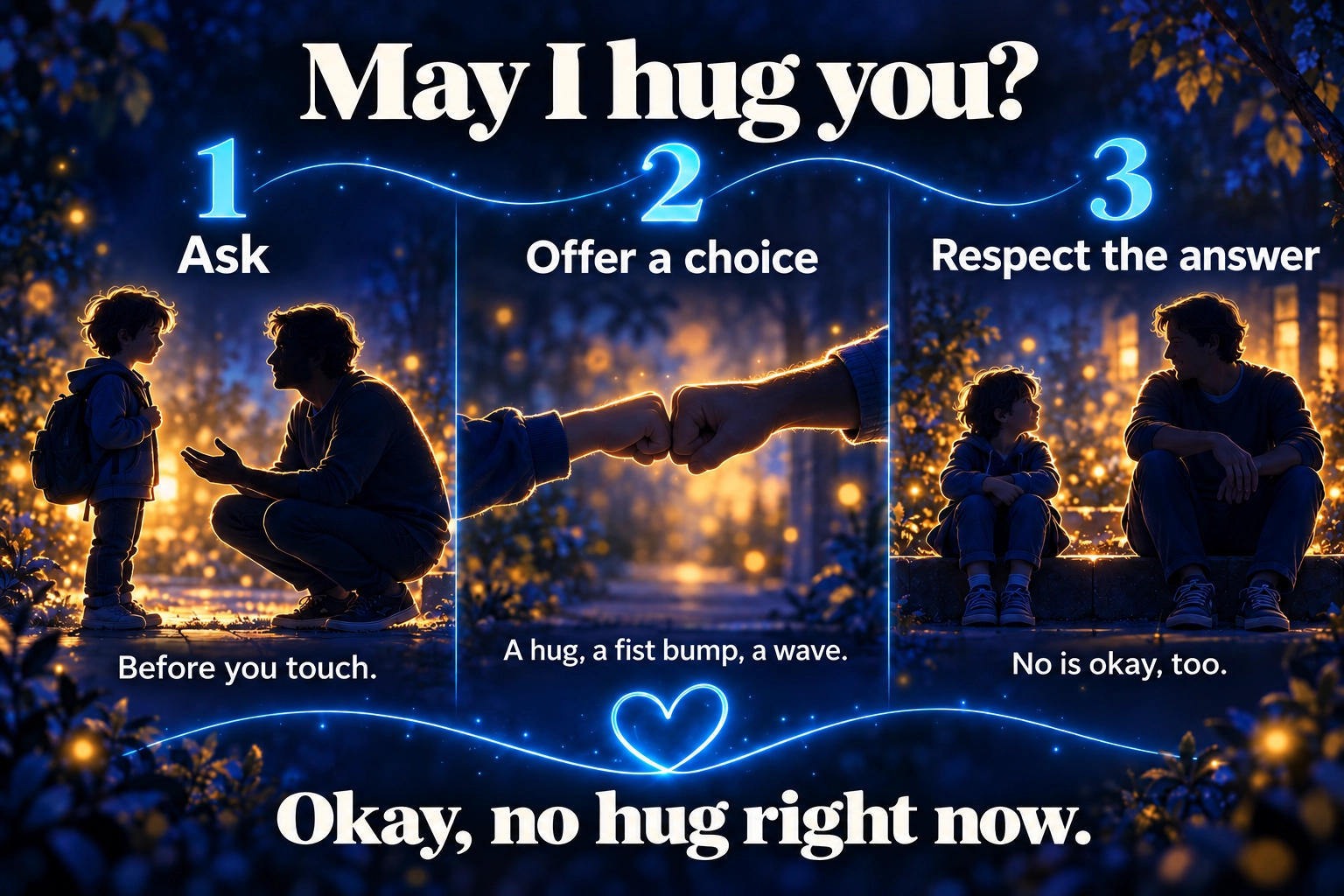
And if the answer is no, smile, hold out your fist, and say:
“Okay, not right now.”
“Believe me, in that moment you gave more than a hug ever could: safety. 💙”
Share:Share
What's your family's sign of connection? A hug, a fist bump, a secret hand signal, or just a smile?
Write to us, and share this letter with someone you think should read it.
Hand in hand, heart to heart — together for a more accepting world. 💙
Oszd meg:Facebook